
Wearable Sensing’s wireless DSI-24 is the leading dry electrode EEG system in terms of signal quality and comfort. The DSI-24 takes on average less than 3 minutes to set up, making it the ideal solution for scientists in need of a simple, easy to use, EEG system. Our patented sensor technology not only delivers uncompromised signal quality but also enables our system to be virtually immune against motion and electrical artifacts. As a result, the DSI-24 can be utilized in virtual or augmented reality, while also allowing researchers to take their experiments out of the lab, and into the real world.
The DSI-24 has sensors that provide full head coverage with 19 electrodes on the head, 2 earclip sensors, and also has 3 built-in auxiliary inputs for acquisition of up to 3 auxiliary sensors. It also has an 8-bit trigger input to synchronize with other devices such as Eye-Tracking, Motion (IMU), and more.
Used around the world by leaders in Research, Neurofeedback, Neuromarketing, Brain-Computer Interfaces, & Neuroergonomics.
With over 90% correlation to research-grade wet EEG systems, the dry sensor interface (DSI) offers unparalleled quality and performance
Multiple adjustment points and a foam pad lined interior enable the system to be worn for up to 8 hours on any head shape or size
All DSI systems include free, unlimited licenses of DSI-Streamer, our data acquisition software which can record raw data, in .csv and .edf file formats
Faraday cage's, spring-loaded electrodes, and our patented common-mode follower technology, provides near immunity against electrical and motion artifacts
Using 70% isopropyl alcohol and a cleaning brush, the DSI-24 only takes a minute to clean, 3 minutes to dry, and can be up and running on the next subject in minutes
All DSI systems include our free C based .dll API, which enables users to pull the raw data directly from the headset, for custom software on Windows, Mac OS, Linux, and ARM
The DSI-24 was designed for ultra-rapid setup, taking on average less than 3 minutes to don, and works on any type of hair, including long hair, thick hair, afros, and more
DSI headsets have active sensors, amplifiers, digitizers, batteries, onboard storage, and wireless transmission, making them complete, mobile, wearable EEG systems
DSI systems exclusively work with QStates, a machine learning algorithm for cognitive classification on states such as mental workload, engagement, and fatigue
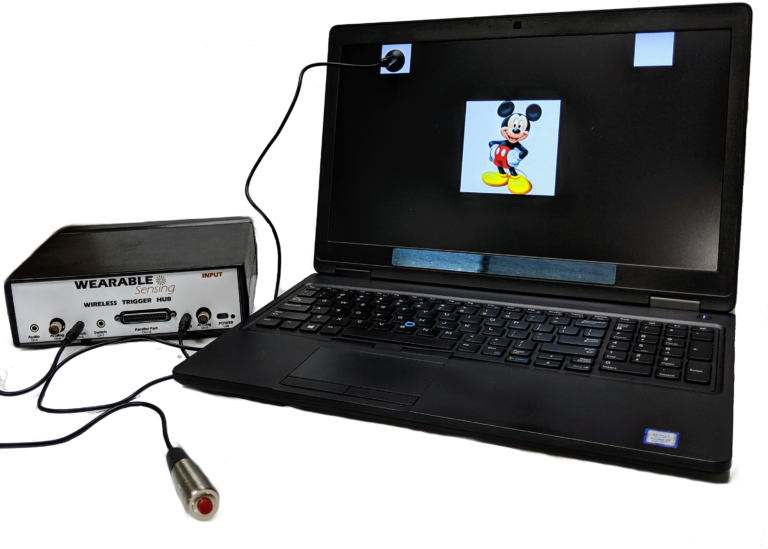
Our Wireless Trigger Hub simplifies the synchronization of DSI headsets with other devices. It features:
An additional benefit of the Trigger Hub design is that it allows synchronization across multiple data sources that are distributed across multiple systems, each of which running at its own clock rate. One such case commonly experienced in EEG experiments involves the synchronization of EEG and eye-tracking measurements, where the inevitable clock drift that arises between two systems during extended measurements creates difficulty in aligning data to events across the two systems.
The DSI-24 has 3 auxiliary inputs on the headset, which allows for automatic synchronization of Wearable Sensing’s auxiliary sensors to the EEG. The sensors available include ECG, EMG, EOG, GSR, RESP, & TEMP. The sensor data is collected and recorded in our data acquisition software, DSI-Streamer, where you can view the EEG and Aux sensors in real-time.
EEG Channels
Fp1, Fp2, Fz, F3, F4, F7, F8, Cz, C3, C4, T7/T3, T8/T4, Pz, P3, P4, P7/T5, P8/T6, O1, O2, A1, A2
Reference / Ground
Common Mode Follower / Fpz
Head Size Range
Adult Size: 52cm – 62cm circumference
Child Size: 48cm – 54cm circumference
Sampling Rate
300 Hz (600Hz upgrade available)
Bandwidth
0.003 – 150 Hz
A/D resolution
0.317 μV referred to input
Input Impedance (1Hz)
47 GΩ
CMRR
> 120 dB
Amplifier / Digitizer
16 bits / 24 channels
Wireless
Bluetooth
Wireless Range
10 m
Run-time
> 24 Hours, Hot-Swappable Batteries
Onboard Storage
~ 68 Hours (available option)
Data Acquisition
Real time, evoked potentials
Signal Quality Monitoring
Continuous impedance, Baseline offset, Noise (1-50 Hz)
Data Type
Raw and Filtered Data available
File Type
.CSV and .EDF
Data Output Streaming
TCP/IP socket, API (C Based), LSL
Cognitive State Classification
Brain Computer Interface
SSVEP BCI Algorithms; BCI2000; OpenViBE; PsychoPy; BCILab
Data Integration / Analysis
CAPTIV; Lab Streaming Layer; NeuroPype; BrainStorm; NeuroVIS
Neurofeedback
Applied Neuroscience NeuroGuide; Brainmaster Brain Avatar; EEGer
Neuromarketing
CAPTIV Neurolab
Presentation
Presentation; E-Prime
Wang, Jun; Li, Zanyang; Yan, Lirong; Imtiaz, Muhammad; Li, Hang; Shoukat, Muhammad Usman; Jinsihan, Jianatihan; Feng, Benjun; Yang, Yi; Yan, Fuwu; others,
UAV Target Detection and Tracking Integrating a Dynamic Brain–Computer Interface Journal Article
In: Drones, vol. 10, no. 3, pp. 222, 2026.
@article{wang2026uav,

title = {UAV Target Detection and Tracking Integrating a Dynamic Brain–Computer Interface},

author = {Jun Wang and Zanyang Li and Lirong Yan and Muhammad Imtiaz and Hang Li and Muhammad Usman Shoukat and Jianatihan Jinsihan and Benjun Feng and Yi Yang and Fuwu Yan and others},

doi = {https://doi.org/10.3390/drones10030222},

year  = {2026},

date = {2026-03-20},

urldate = {2026-01-01},

journal = {Drones},

volume = {10},

number = {3},

pages = {222},

publisher = {MDPI},

abstract = {To address the inherent limitations in the robustness of fully autonomous unmanned aerial vehicle (UAV) visual perception and the high cognitive workload associated with manual control, this paper proposes a human-in-the-loop brain–computer interface (BCI) control framework. The system integrates steady-state visual evoked potential (SSVEP) with deep learning techniques to create a spatio-temporally dynamic interaction paradigm, enabling real-time alignment between visual targets and frequency stimuli. At the perception level, an enhanced YOLOv11 network incorporating partial convolution (PConv) and shape intersection over union (Shape-IoU) loss is developed and coupled with the DeepSort multi-object tracking algorithm. This configuration ensures high-speed execution on edge computing platforms while maintaining stable stimulus coverage over dynamic targets, thus providing a robust visual induction environment for EEG decoding. At the neural decoding level, an enhanced task-discriminant component analysis (TDCA-V) algorithm is introduced to improve signal detection stability within non-stationary flight conditions. Experimental results demonstrate that within the predefined fixation task window, the system achieves 100% success in maintaining target identity (ID). The BCI system achieved an average command recognition accuracy of 91.48% within a 1.0 s time window, with the TDCA-V algorithm significantly outperforming traditional spatial filtering methods in dynamic scenarios. These findings demonstrate the system’s effectiveness in decoupling human cognitive intent from machine execution, providing a robust solution for human–machine collaborative control.},

keywords = {},

pubstate = {published},

tppubtype = {article}

}
di Belle Arti Napoli, Accademia
Temporal Dynamics of Functional Connectivity during Neuroaesthetic Experience: Effects of Art Expertise and Psychological Traits Journal Article
In: 2026.
@article{ditemporal,

title = {Temporal Dynamics of Functional Connectivity during Neuroaesthetic Experience: Effects of Art Expertise and Psychological Traits},

author = {Accademia di Belle Arti Napoli},

url = {https://www.researchgate.net/profile/Pietro-Tarchi/publication/401637294_Temporal_Dynamics_of_Functional_Connectivity_During_Neuroaesthetic_Experience_Effects_of_Art_Expertise_and_Psychological_Traits/links/69aeb209ceb31f79ab25270a/Temporal-Dynamics-of-Functional-Connectivity-During-Neuroaesthetic-Experience-Effects-of-Art-Expertise-and-Psychological-Traits.pdf},

year  = {2026},

date = {2026-03-14},

abstract = {In recent years, neuroaesthetics has highlighted how the experience of art engages brain networks related to perception, cognition, and emotion. In this study, electroencephalography (EEG) was recorded from 35 participants (22.86 ± 1.96 years) while they viewed 70 artworks. Functional connectivity was estimated with the Phase Lag Index across theta, alpha, beta, and gamma bands, and graph-theoretical metrics were derived. Analyses were conducted separately for early (0-1 s) and later (1-2 s) post-stimulus epochs, comparing experts and non-experts, as well as high- and low-empathy individuals (defined based on Interpersonal Reactivity Index scores). Results revealed that expertise exerted its strongest influence during the first second of processing, characterized by reduced theta transitivity and betweenness and increased alpha participation, particularly for familiar artworks. In the second epoch, expertise effects became more selective, with differences in beta and gamma metrics. Empathy effects, by contrast, were weaker in the first second, whereas in the second epoch empathic individuals exhibited more robust modulations, including higher path length, modularity, and altered clustering and centrality across alpha, beta, and gamma bands for high-valence and high-arousal artworks. These findings suggest that art expertise predominantly shapes early, familiarity-driven connectivity, whereas empathy modulates later affective stages of processing.

},

keywords = {},

pubstate = {published},

tppubtype = {article}

}
Seo, Ssang-Hee
Development of Drowsy Driving Detection System Using EEG Journal Article
In: Tehnički glasnik, vol. 20, no. 1, pp. 86–93, 2026.
@article{seo2026development,

title = {Development of Drowsy Driving Detection System Using EEG},

author = {Ssang-Hee Seo},

doi = {https://doi.org/10.31803/tg-20250326030355},

year  = {2026},

date = {2026-03-13},

urldate = {2026-01-01},

journal = {Tehnički glasnik},

volume = {20},

number = {1},

pages = {86–93},

publisher = {Sveučilište Sjever},

abstract = {Drowsy driving is a major contributor to serious traffic accidents, highlighting the urgent need for effective real-time detection systems. This study proposes a real-time drowsiness detection system based on electroencephalogram (EEG) signals and a lightweight convolutional neural network (CNN). The system comprises five main components: EEG signal acquisition, preprocessing, feature extraction, CNN-based classification, and user feedback delivery via an Android application. The experiment involved four healthy adult male participants with an average age of 24.5 years. EEG data were collected using the DSI-24 device, and the relative power in the alpha band from the prefrontal (Fp1, Fp2) and occipital (O1, O2) regions was identified as the primary feature for distinguishing drowsiness. The proposed CNN model, trained on these features, achieved a classification accuracy of 91.56%, comparable to the 92.66% accuracy of the more complex AlexNet model, while being significantly more lightweight and suitable for real-time deployment on embedded systems. The Android application provides real-time feedback on the user’s drowsiness level and recommends nearby rest areas to help mitigate the risk of drowsy driving. This study presents a practical and efficient EEG-based driver monitoring solution. Future work will focus on large-scale data collection under actual driving conditions to further validate and improve the system’s performance.},

keywords = {},

pubstate = {published},

tppubtype = {article}

}
Xu, Zihua; Li, Tianjun; Chen, CL Philip; Zhang, Tong
F2FNet: An Efficient Affective State Analysis Network Reconstructing EEG From Few-Channel To Full-Channel Journal Article
In: IEEE Transactions on Affective Computing, 2026.
@article{xu2026f2fnet,

title = {F2FNet: An Efficient Affective State Analysis Network Reconstructing EEG From Few-Channel To Full-Channel},

author = {Zihua Xu and Tianjun Li and CL Philip Chen and Tong Zhang},

doi = {10.1109/TAFFC.2026.3671843},

year  = {2026},

date = {2026-03-09},

urldate = {2026-01-01},

journal = {IEEE Transactions on Affective Computing},

publisher = {IEEE},

abstract = {Due to the prohibitive costs and lack of portability associated with full-channel devices, portable miniature EEG devices with only a few electrodes (few-channel) are more suitable for widespread deployment in consumer applications. However, affective state analysis with few-channel EEG presents a significant challenge, as these devices only capture signals from partial brain regions. Existing approaches designed for few-channel devices do not adequately account for the critical role of whole-brain connectivity and suffer from the impact of noise in affective state analysis. To address the challenges, we propose an efficient affective state analysis Network which reconstructs EEG from Few-channel To Full-channel (F2FNet). This method aims to leverage knowledge from full-channel EEG and exclude irrelevant information to enhance the affective state analysis performance of few-channel EEG based on whole-brain connectivity patterns. To ensure information validity and consistency during the reconstruction process, we introduce mechanisms for information compression and control. Additionally, we perform alignment of compressed features within the VAD emotional space to ensure that the model's understanding and extraction of emotional features conform to the definitions of affective theories. Extensive experiments on basic emotion recognition and depression detection demonstrate the efficacy of the proposed method.},

keywords = {},

pubstate = {published},

tppubtype = {article}

}
Jain, Sparsh; Perez, Miguel A
Physiological Sensing for Driver State Monitoring: Technology Scan and Pilot Evaluation PhD Thesis
2026.
@phdthesis{jain2026physiological,

title = {Physiological Sensing for Driver State Monitoring: Technology Scan and Pilot Evaluation},

author = {Sparsh Jain and Miguel A Perez},

url = {https://vtechworks.lib.vt.edu/items/026e66e1-3845-4b1f-9e3c-5d6b4c0b9d51},

year  = {2026},

date = {2026-03-04},

urldate = {2026-01-01},

institution = {National Surface Transportation Safety Center for Excellence},

abstract = {As advanced driver assistance systems and automated vehicle technologies evolve, the ability to monitor and assess driver readiness remains critical. In support of that need, this report describes several efforts to evaluate the feasibility and reliability of capturing physiological signals during real-world driving. The goal was to examine whether signals from respiration, cardiac activity, and brain function, captured via wearable and non-contact sensors, could complement existing driver monitoring methods and provide useful input for future in-vehicle systems. A review of the literature supporting respiration, cardiac, and brain activity as relevant domains for driver state monitoring was the initial step in this process. These physiological channels are discussed as potentially useful complements to traditional measures like eye behavior, especially given their links to autonomic and cognitive changes under various degraded states. The literature review was complemented by a technology scan of commercial and research-grade devices capable of measuring these signals in mobile contexts. A structured protocol for exercising an initial subset of these systems during impaired driving in a closed-course environment was also developed. This protocol was then executed in a pilot test with five participants, who completed standardized baseline and post-alcohol drives while instrumented with electrocardiogram (ECG), respiration, and electroencephalography (EEG) sensors in addition to sensors capturing driving performance and glance behavior. In this pilot study, alcohol was used as a convenient physiological stressor given its well-understood dosage effects on driving and physiology. Results indicated that alcohol consumption consistently altered some behavioral physiological signals across all three domains. Physiological responses were more robust and consistent than the observable driving metrics, potentially highlighting the complementary value of these signals. The small sample size, however, resulted in a lack of power to detect statistical significance between sober and impaired driving for most metrics. Respiration and ECG signals were captured with high reliability, while EEG results provided informative patterns but suffered from variable signal quality and motion artifacts. These findings support the initial viability of cardiac and respiratory sensing in mobile in-vehicle settings and highlight practical limitations that must be addressed for EEG. Altogether, the effort demonstrates that it is technically feasible to capture and interpret physiological signals in a real-world driving context using wearable and embedded sensors. While further validation is needed, the results provide a foundation for integrating such signals into future driver state monitoring systems, not as standalone indicators, but as part of a multimodal approach that reflects the complexity of driver physiology and behavior.},

keywords = {},

pubstate = {published},

tppubtype = {phdthesis}

}
Kim, Sanghee; Yoon, Seonghwan; Ryu, Jihye; Lee, Yujeong
Sex differences in thermal sensation and EEG responses during thermal transitions in non-neutral thermal environments within buildings Journal Article
In: Architectural Science Review, pp. 1–21, 2026.
@article{kim2026sex,

title = {Sex differences in thermal sensation and EEG responses during thermal transitions in non-neutral thermal environments within buildings},

author = {Sanghee Kim and Seonghwan Yoon and Jihye Ryu and Yujeong Lee},

doi = {https://doi.org/10.1080/00038628.2026.2619000},

year  = {2026},

date = {2026-02-25},

urldate = {2026-01-01},

journal = {Architectural Science Review},

pages = {1–21},

publisher = {Taylor & Francis},

abstract = {The personalized comfort model (PCM) offers a promising approach to improving building energy efficiency by integrating individual physiological differences. However, sex-based variability in thermal perception remains insufficiently understood. This study investigated subjective thermal sensation votes (TSVs) and electroencephalogram (EEG) responses of male (n = 16) and female (n = 16) participants during transitions between warm – cool (PMV +2 → −2) and cool – warm (PMV −2 → + 2) environments.


Significant sex differences (p < 0.05) in TSVs were observed 3–15 min after transitioning from warm to cool conditions. Despite being in the same thermally neutral – cool environment, males (TSVm = −1.15) and females (TSVf = −2.15) reported approximately a one-unit difference on the TSV scale immediately after entry.


EEG analysis revealed significant sex differences (p < 0.05) in the right lateral beta (RLB), right medial beta (RMB), and sensorimotor rhythm (SMR) bands – frequency ranges associated with subjective thermal sensation – with distinct sex-specific activation observed in the occipital region.


The correlation between TSV and EEG further confirmed that EEG activity reflects subjective thermal perception.


These findings demonstrate that EEG can serve as a physiological indicator of thermal comfort and underscore the importance of sex-specific approaches in developing personalized thermal comfort models.},

keywords = {},

pubstate = {published},

tppubtype = {article}

}
Lee, Meesung; Shahrokhi, Eren; Ahmed, Syed Nizam; Lee, Gaang
Feasibility Study on Microstate Analysis to Enhance Generalizability in EEG Research of Construction Workers’ Cognitive States Journal Article
In: Computing in Civil Engineering 2025: Computational and Intelligent Technologies, pp. 971–979, 2026.
@article{lee2025feasibility,

title = {Feasibility Study on Microstate Analysis to Enhance Generalizability in EEG Research of Construction Workers’ Cognitive States},

author = {Meesung Lee and Eren Shahrokhi and Syed Nizam Ahmed and Gaang Lee},

doi = {https://doi.org/10.1061/9780784486436.104},

year  = {2026},

date = {2026-01-28},

booktitle = {Computing in Civil Engineering 2025: Computational and Intelligent Technologies},

journal = {Computing in Civil Engineering 2025: Computational and Intelligent Technologies},

pages = {971–979},

abstract = {The safety and productivity of construction projects are closely tied to workers’ cognitive states. Traditional methods for assessing these states often suffer from self-report bias and lack dynamic tracking. Electroencephalogram (EEG) provides an objective, real-time alternative, but its utility is limited by poor generalizability due to inter-individual variability. EEG microstate analysis, which converts EEG signals into cross-population brain network patterns, may buffer these differences and improve model performance. This study investigates the feasibility of using EEG microstates to enhance the generalizability of cognitive state classification among construction workers. EEG data labeled as desirable or undesirable cognitive states were collected during cognitively demanding tasks. Deep learning models were trained with and without EEG microstates using leave-one-subject-out validation. Results show that integrating microstates consistently improved classification accuracy, even with identical data volumes. These findings highlight the value of microstates in capturing individual variability and advancing EEG-based cognitive monitoring in construction settings.},

keywords = {},

pubstate = {published},

tppubtype = {article}

}
Olikkal, Parthan; Mebaghanje, Oritsejolomisan; Janeja, Viraj; Moharrer, Golnaz; Ajendla, Akshara; Sundharram, Sruthi; Kleinsmith, Andrea; Clemmensen, Ann Sofie; Vinjamuri, Ramana
SIVAM: Synergy-Based Intuitive Virtual and Augmented Therapy for Mental Health Journal Article
In: Bridging the Gap between Mind and Machine, pp. 343, 2026.
@article{olikkalsivam,

title = {SIVAM: Synergy-Based Intuitive Virtual and Augmented Therapy for Mental Health},

author = {Parthan Olikkal and Oritsejolomisan Mebaghanje and Viraj Janeja and Golnaz Moharrer and Akshara Ajendla and Sruthi Sundharram and Andrea Kleinsmith and Ann Sofie Clemmensen and Ramana Vinjamuri},

url = {https://link.springer.com/chapter/10.1007/978-3-032-06713-5_17},

year  = {2026},

date = {2026-01-20},

journal = {Bridging the Gap between Mind and Machine},

pages = {343},

publisher = {Springer},

abstract = {With growing mental health challenges among populations and limited access to in-person therapy, there is a critical need for accessible, personalized, and non-pharmacological interventions. To address this, we developed the Synergy-based Intuitive Virtual and Augmented Therapy for Mental Health (SIVAM) platform, a real-time home-deployable system that delivers emotionally responsive dance movement therapy (DMT). SIVAM integrates full-body and hand motion capture, avatar-based interaction, and humanoid robot mirroring, while simultaneously recording multimodal physiological signals (EEG, EMG, ECG, GSR, temperature). By extracting motor synergies and affective biomarkers, the system aims to adapt choreography and feedback to the user’s emotional and physical state. The platform demonstrates low-latency communication, high-fidelity mapping of body landmarks to avatars and robots, and seamless synchronization between movement and biofeedback. A pilot study confirmed SIVAM’s effectiveness across user profiles, supporting its potential as an emotion-aware, scalable therapeutic solution tailored to the need of individuals.


},

keywords = {},

pubstate = {published},

tppubtype = {article}

}
Chen, Yi-Cian; Chang, Huai-Jen; Chang, Ching-Wen; Li, Jia-Ling; Lu, Hsinjie; Cheng, Chia-Hsiung
Prolonged Mismatch Negativity Latencies in Intensive Care Unit Patients With Active Delirium Journal Article
In: Journal of Clinical Neurophysiology, 2026.
@article{chen2026prolonged,

title = {Prolonged Mismatch Negativity Latencies in Intensive Care Unit Patients With Active Delirium},

author = {Yi-Cian Chen and Huai-Jen Chang and Ching-Wen Chang and Jia-Ling Li and Hsinjie Lu and Chia-Hsiung Cheng},

url = {https://www.ovid.com/jnls/clinicalneurophys/abstract/10.1097/wnp.0000000000001238~prolonged-mismatch-negativity-latencies-in-intensive-care},

year  = {2026},

date = {2026-01-16},

urldate = {2026-01-01},

journal = {Journal of Clinical Neurophysiology},

abstract = {Introduction:

Delirium is a common and serious complication in critically ill patients, associated with higher mortality, prolonged intensive care unit (ICU) stays, and cognitive impairments. Furthermore, renal dysfunction is a well-recognized risk factor for delirium in the ICU. Although previous studies have explored the neurophysiologic characteristics of delirium, few have examined brain activity during active delirium episodes. To address this gap, this study aimed to use mismatch negativity (MMN)—an electrophysiologic marker of the brain's automatic ability to detect environmental changes—to deepen the understanding of the pathophysiology and phenomenology of delirium in ICU patients with renal dysfunction.


Methods:

An auditory oddball paradigm, consisting of frequent standard tones and infrequent deviant tones, was presented to critically ill patients with renal dysfunction during event-related potential recordings. MMN was obtained by subtracting the event-related potential response to deviant stimuli from that of standard stimuli and was compared between patients with and without delirium. In addition, the authors examined the relationships between MMN, cognitive function, and disease severity. Finally, they assessed whether MMN could predict key clinical outcomes at ICU discharge.


Results:

ICU patients with delirium exhibited significantly prolonged MMN latencies compared with those without delirium (P = 0.005, effect size = 0.67). Moreover, more delayed MMN latencies showed a trend toward an association with greater delirium severity. However, MMN did not predict key clinical outcomes on ICU discharge.


Conclusions:

Critically ill patients with renal dysfunction exhibit prolonged MMN latencies during delirium episodes compared with those without delirium, suggesting altered neural processing in this population.},

keywords = {},

pubstate = {published},

tppubtype = {article}

}
Gupta, Disha; Brangaccio, Jodi; Mojtabavi, Helia; Hill, Nicholas Jeremy
A portable cortical evoked potential operant conditioning system (C-EPOCS): System development Unpublished
2026.
@unpublished{gupta2026portable,

title = {A portable cortical evoked potential operant conditioning system (C-EPOCS): System development},

author = {Disha Gupta and Jodi Brangaccio and Helia Mojtabavi and Nicholas Jeremy Hill},

url = {https://www.biorxiv.org/content/10.64898/2026.01.08.698448v1.abstract},

year  = {2026},

date = {2026-01-09},

urldate = {2026-01-01},

journal = {bioRxiv},

pages = {2026–01},

publisher = {Cold Spring Harbor Laboratory},

abstract = {This study presents customizations and evaluations aimed at adapting the Cortical-Evoked Potential Operant Conditioning System (C-EPOCS) into a portable, user-friendly platform for real-time neurofeedback applications. A primary goal was to simplify the component-heavy setup by integrating electroencephalography (EEG) and electromyography (EMG) data acquisition into a single system—while still supporting cortical and muscle response assessment and real-time feedback.


One key limitation of portable biosignal acquisition systems is their typically lower sampling rates (e.g., 300–600 Hz) compared to high-resolution systems (e.g., 3200 Hz), which are commonly used for detecting transient responses such as the H-reflex and M-wave. In a C-EPOCS setup, these responses are useful for determining the target stimulation intensity and minimizing inter-session variability in effective afferent excitation.


We evaluated whether lower-resolution EMG signals could still support the generation of H-reflex and M-wave recruitment curves for determining target stimulation intensity. Results showed that while EMG sampled at ∼600 Hz and ∼300 Hz produced greater dispersion in recruitment curve data—particularly at 300 Hz—they still yielded comparable estimates for stimulation intensities that elicit Hmax and Mthreshold, the key parameters for C-EPOCS. Additionally, we demonstrate the feasibility of using an automated response delineation algorithm under these conditions. Despite reduced signal clarity, the algorithm reliably identifies M-wave and H-reflex responses in real time.


Overall, this study demonstrates the feasibility of a portable C-EPOCS system capable of providing immediate feedback based on both EMG and EEG signals. It also offers practical recommendations for selecting acquisition hardware to support reliable signal quality, real-time processing, and portability.},

keywords = {},

pubstate = {published},

tppubtype = {unpublished}

}